How to Tell If TEREA Sticks Are Authentic: 2026 Checklist
Counterfeit packaging can look convincing, while legitimate TEREA packs can differ from one market to another. That makes authenticity a question of consistency rather than one “secret” code or printing detail.
Use several checks together: the condition of the sealed retail pack, the exact product name, the regional labeling, the seller’s handling policy, and whether the item matches the listing you ordered. No visual checklist can prove authenticity on its own, but it can help you recognize when an order deserves a closer look.
Quick TEREA authenticity checklist
Before opening the pack, check the following:
- The retail packaging is closed and shows no obvious signs of rewrapping or tampering.
- The flavor name and regional edition match the product you ordered.
- Text, logos, colors, and warning panels are aligned and legible.
- The carton and individual packs are not crushed, wet, punctured, or unusually loose.
- The seller clearly explains whether products are relabeled or repackaged.
- Tracking and support information are available if the order arrives damaged or different from the listing.
Treat these as combined signals. A clean print job does not prove that a pack is genuine, and a small regional design difference does not automatically make it counterfeit.
Start with sealed retail condition
The simplest first check is the physical state of the product. A sealed retail pack should arrive closed, without an extra layer of improvised wrapping, loose corners, or evidence that the original packaging was opened.
CruseStick states that its TEREA inventory is shipped in sealed retail packaging and is not relabeled or repackaged. If you are comparing an order with the website, start with the exact listing or browse the complete TEREA catalog.
Damage is not the same thing as counterfeiting. A carton can be dented during delivery. The useful question is whether the damage is consistent with shipping or whether the pack appears to have been opened, altered, or assembled from mismatched parts.
Expect legitimate regional differences
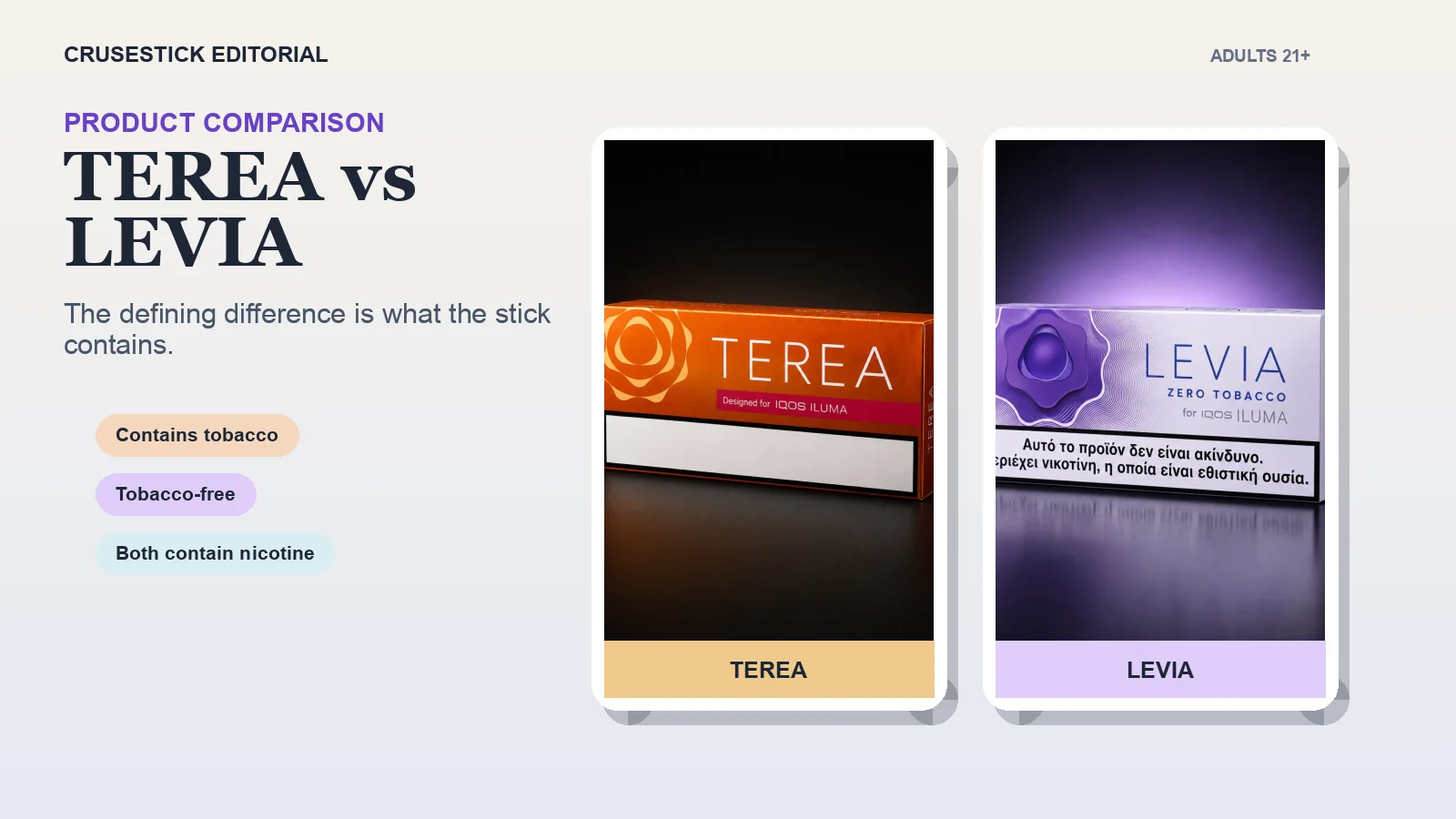
TEREA is sold in multiple markets, so packaging can vary by region. Language, warning panels, tax markings, layout, and even the available flavor names may differ between European, Japanese, Middle Eastern, and Indonesian releases.
For example, compare the current TEREA Europe collection with the TEREA Japan collection. Different presentation is expected; the important point is whether the pack matches the regional edition advertised in the listing.
A Japanese pack should not be rejected simply because it does not look like a European pack. At the same time, an order advertised as one regional variant but delivered as another should be questioned.
Compare the exact product name and edition
Use the product page from your order confirmation as the reference point. Check:
- Flavor or variant name.
- Regional collection.
- Pack color and major design elements.
- Warning-label placement and language.
- Any edition wording printed on the pack.
Packaging can be refreshed over time, so an online image is not permanent proof. It is still useful for confirming that the product family and regional edition are consistent with what you bought.
If the name, region, and general presentation do not agree, photograph the unopened pack and contact the seller before using it.
Print quality helps, but it is not proof
Obvious printing problems deserve attention: blurred small text, badly cropped warning panels, inconsistent colors across packs in the same carton, or spelling errors in the main product name.
However, modern counterfeit packaging can reproduce logos and codes. That is why print quality should support the rest of the checklist rather than decide the result by itself.
The opposite is also true. Minor shifts in color, label position, or warning layout can come from regional requirements or packaging updates. Avoid declaring a product counterfeit based on a single small difference.
Do not rely on one code
Buyers often search for a serial, batch, QR, or pack code that can provide a definitive answer. Codes may help identify a batch or market, but their presence alone does not establish authenticity. Printed information can be copied, and code formats can vary.
Use any code as one piece of evidence. It should agree with the rest of the pack and the regional edition, but it should not replace checks of packaging condition, product identity, and seller transparency.
Evaluate the seller as well as the pack
Authenticity checks begin before delivery. A retailer should make it easy to understand:
- What regional product is being sold.
- Whether the item remains in sealed retail packaging.
- Whether it is relabeled or repackaged.
- How orders are tracked.
- How damaged or mis-described items are handled.
- How to contact support.
CruseStick describes itself as an independent online retailer rather than an authorized IQOS distributor. That distinction should remain clear in product and blog content. You can review current shipping, order, and product information in the CruseStick FAQ.
Be cautious when a seller uses stock images for every variant, hides the regional edition, or refuses to answer basic questions about pack condition and fulfillment.
What to do when a pack looks wrong
If something does not match your order:
- Keep the carton and packs unopened.
- Photograph the shipping box, seals, labels, and the area of concern.
- Compare the flavor and region with the original product page.
- Contact the retailer with the order number and photos.
- Do not rely on social-media comments as the only verdict.
This gives the seller enough information to check whether the issue is shipping damage, a regional packaging update, incorrect fulfillment, or something more serious.
Frequently asked questions
Can packaging prove that TEREA is authentic?
Not by itself. Seals, printing, codes, regional labels, order records, and seller transparency should be considered together.
Are European and Japanese TEREA packs supposed to look different?
They can. Regional products may use different languages, warning panels, tax markings, and layouts. Compare the pack with the specific region advertised by the seller.
Does a QR or batch code guarantee authenticity?
No. A code can support a review, but it can also be copied and may use a market-specific format. Do not treat one code as conclusive.
Is a damaged carton automatically counterfeit?
No. Delivery damage and counterfeiting are different issues. Photograph the unopened product and ask the retailer to review it.
A careful approach works best
The most reliable consumer-level approach is a layered one: confirm sealed retail condition, match the exact flavor and regional edition, review the print and warning panels, and evaluate the seller’s handling and support policies.
CruseStick supplies regional TEREA products in sealed retail packaging with tracked US shipping for adults 21+. If a pack does not match the listing, keep it unopened and contact support before making assumptions.
Related Articles
Related on CruseStick
Categories you might like
Ready to Try TEREA?
Browse our selection of authentic IQOS TEREA sticks. Fast shipping across the USA with competitive prices.
Shop Now